By Lilly Yurchenko
Nuclear power should be considered as a safe and major energy source. It has a very high power density per amount of fuel you consume and also takes a long time to use up the fuel.
For example, unlike coal one gram of U235 has an energy density of ~83,000 gigajoules (GJ) and is used up (in high power reactors like naval submarines (so worst case)) in about 3 hours while for one gram of coal the energy density is ~32 Kilojoules (kJ) and burns up in about 1 to 1000 seconds This shows how nuclear energy is more efficient at producing power than other common sources like coal.
While there have been accidents at multiple nuclear reactors such as Chernobyl, Three Mile Island and Fukushima that have caused serious hazards to their surroundings these accidents have been few and far between because of the 440 currently operating only three incidents have occurred with the most recent one happening in March 11 2011 An example of using nuclear power as a major energy source is France with approximately 65% to 70% of their power coming from nuclear sources while also not having any meltdowns or serious accidents
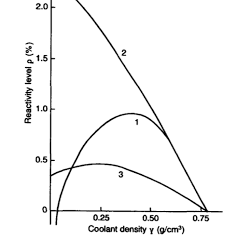
However one could argue that even though accidents are rare when they happen they are usually very bad. An example of this, is the catastrophic meltdown of the Chernobyl Reactor Unit 4. This did not occur due to the fuel being unsafe but rather the lack of knowledge and measuring instruments allowing the reactor to get to a critical change in thermal power of 530 MW in 3 seconds and melting the fuel rod assemblies while flash boiling coolant water this is a problem because as illustrated in Figure 1 when the reactor cooling water boils the voids of steam actually raise reactivity instead of moderating it like the rest of the liquid water it causes a positive feedback loop that will continuously raise the heat and power in the reactor until it detonates due to heat and pressure
Figure 1: High positive void coefficient
Source: page 137 https://www-pub.iaea.org/MTCD/Publications/PDF/Pub913e_web.pdf
Fortunately, in today’s modern times better instruments and reactor designs such as the PWR (Pressurised Water Reactor) have negative void coefficients so the steam actually stabilizes the reaction. In addition, newer fuels being researched like thorium actually lose reactivity when heated. This causes the heat to drop which creates a self regulating effect that can aid in control of the reactor within safe limits. This is because thorium is usually used as a molten liquid salt that expands when it gets hot thus increasing the distance between atoms and reducing the rate of reaction.
This demonstrates that even though in the past nuclear power was not as safe as now. Major advancements in safety and regulations have made it a viable and safe power source.